Educational Game
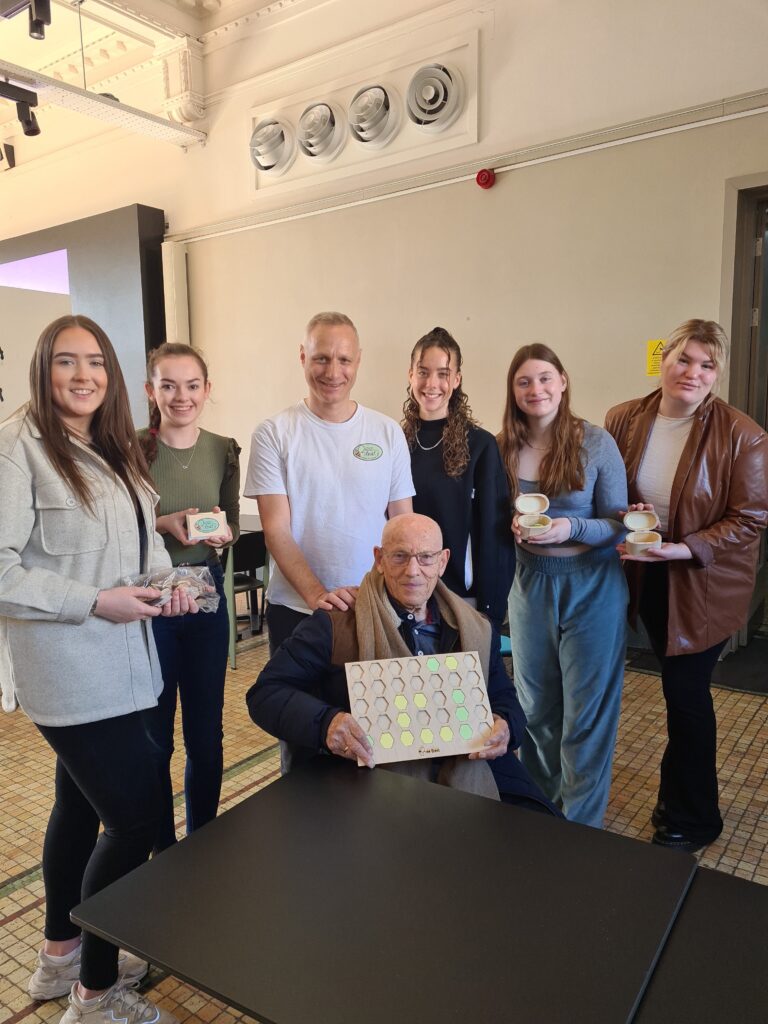
The image above shows the students who were involved in creating this spectacular game. The names of these students are as follows; Georgia Woolley, Lucy Jenkins, Annie Holdt, Cat Moxley, Katy Michallatl and Simran Dhillon. All their hard work has been appreciated and is shown on our Thank Your Wall. To visit our Thank You Wall and see all contributions from other students, volunteers, partners and more, click the button below.
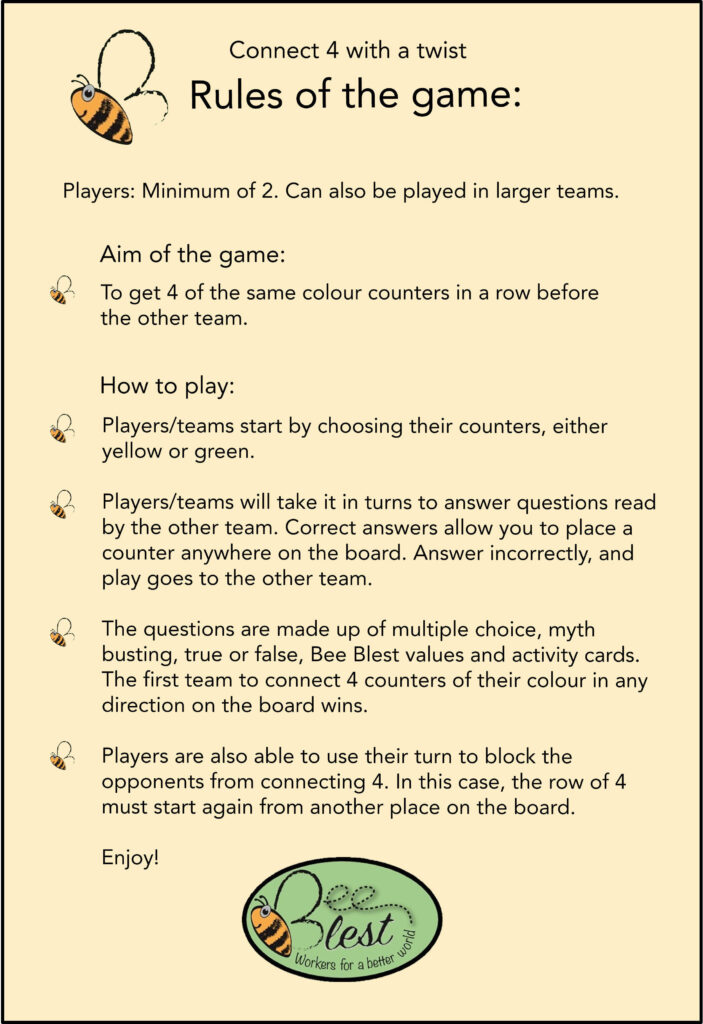
A group of students at Sheffield Hallam University who study Architecture have developed and created an educational game. (Can be seen in the image to the left being held by my father.) This is one of the games that will be played at the educational sessions that can be booked at the bottom of the page. The rules of the game can be seen below.
Rivelin Woodland Skills
Fees will be included in whatever Simon charges you for the full RWS plus BB experience.
This collaboration will continue in a limited way and you can check out the RWS site, especially if you wish your children to learn some woodland skills as well. These sessions are only held during School Holidays and will include 2 hours of a mixed bag of bee related activities (partly depending on the children’s previous experience) with more information available from Simon nearer the time.
Please check out their website(by clicking the RWS page button). Children’s educational sessions are now being provided at Bee Blest Apiary as a purely Honey Bee related experience. Andrzej has an advanced DBS and will be working with one other adult – either a parent or one of his volunteers. Because of the nature of the work with bees and the seasons, the sessions will only be held between the middle of April and the end of October each year and will be available to the general public during School Holidays. The actual dates available for these in 2023 are not yet known and will be published in early 2023.
Book a session form
Session options
Session A is a standalone and a taster really. Sessions B, C and D can be done as standalones or combined in any way. All together they would provide quite a comprehensive course with reduced rates if booked and paid for up front.
A. A two-hour general introduction to bees, pollination and beekeeping (including making candles) – a bit of everything. This includes seeing bees in an observation hive. The session can be delivered in a home / away from the apiary site.
B. 1-2 (1.5 hour) sessions focusing mainly on honeybees, including seeing bees in action (in an observation hive), using a microscope and learning a bit about beekeeping. Specify if wanting one or two 1.5 hour sessions. Either or both together would be good intro before session D. This session would probably be best delivered away from the apiary site.
C. One two-hour session covering pollination and environmental issues. This will include identifying plants and crops at the apiary and adjoining allotments as well as microscopy. Observing bees at the hive entrances included.
D. A fully immersive two-hour session in full bee suits – watching / helping me inspect a colony, learning as we go along. Some background beforehand such as 1-2 sessions under B would be helpful preparation for this but not essential. This session is weather dependent.
Payment
For any session to be viable we need between 3 and 6 children, 4-5 being the ideal number.
Current Cost (may be revised)
For groups of 3-4 children: £15 each – payable in advance
For groups of 5-6 children: £12 each – payable in advance
If children are siblings a reduction in cost may be negotiable.
If a parent can be present, the total cost for the group will be cut by £5.00 as there will be no need for expenses for an assistant volunteer.